AI Act Article 50: does your chatbot need to say it's AI? (since 2 August 2026)
· 6 min read · Robin Broers
Yes, your chatbot has to say that visitors are talking to AI. Since 2 August 2026, Article 50 of the European AI Act requires every chatbot on a website to make that disclosure, at the first interaction at the latest. Most business owners have missed it.
The reason: many small-business owners think the AI Act has been postponed to 2027 or 2028. That's true for a large part of the rules, but not for Article 50. That transparency duty applies now.
Just look at my own chatbot, in the bottom corner of this page: below the input field it clearly states that you're talking to an AI chatbot. That is exactly what the law now asks for.
What Article 50 means in plain language
The core is openness: people must always know when they're dealing with AI. Concretely, Article 50 (in force since 2 August 2026, source: artificialintelligenceact.eu) covers:
- Direct interaction: if someone talks to a chatbot or AI assistant, that has to be clear (unless it's obvious).
- Synthetic content: AI that generates text, images, audio or video must mark that output as AI-generated in a machine-detectable way.
- Emotion recognition and biometrics: if you use such systems, you must inform the people involved.
- Deepfakes and public information: deepfakes must be labelled as such. So must AI text on matters of public interest, unless a human has editorially reviewed the content.
- Form and timing: the notice must be clear and visible at the first interaction at the latest, accessible to everyone.
- Relation to other rules: this is separate from the requirements for high-risk AI (Chapter III).
- Implementation: the AI Office supports codes of practice for detection and labelling.
In short: people must always know when they're talking to AI, or when content was artificially generated.
What such a notice can look like
An AI notice complies if it is visible at the first interaction at the latest: in the bot's opening message, or as a fixed line below the input field. The law doesn't prescribe a form, and a popup isn't needed. The difference is in the placement and how easy it is to find.
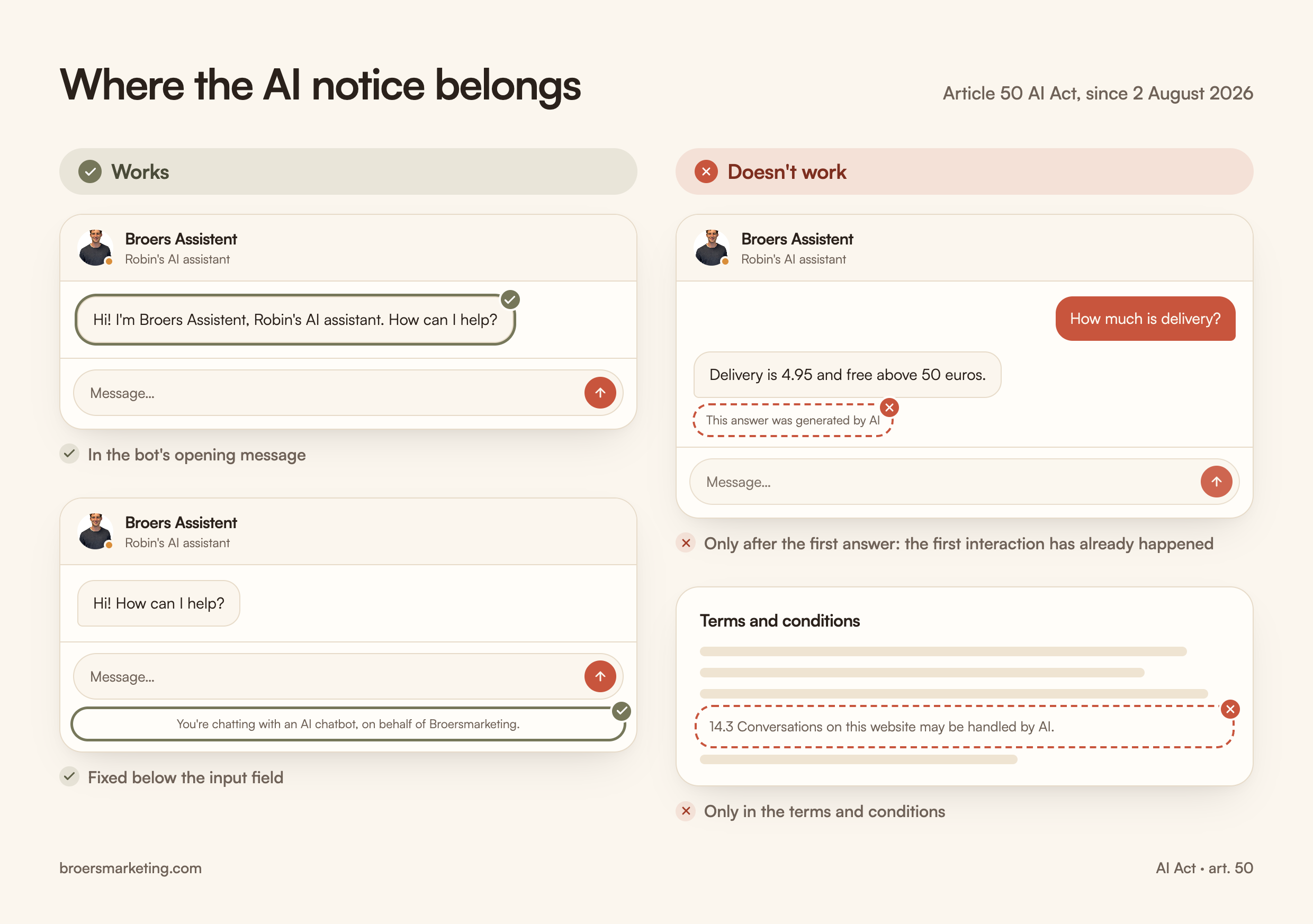
What works:
- An opening message from the bot.
- A fixed line below the input field. It's there before someone types their first question, stays for the whole conversation, and is less intrusive.
What doesn't:
- A block that only appears below the first answer. By then the first interaction has already happened, and paragraph 5 requires the notice at that moment at the latest.
- A notice that only lives in the terms and conditions or on a separate explainer page.
Checklist: are you covered?
Your chatbot meets Article 50 if you can say yes to every question below:
- Does the first interaction state that it's AI, and not only after the first question?
- Is that notice real text in the page, visible without hovering and readable by a screen reader?
- Does it say on behalf of which organisation the AI speaks?
- Is it clear how a visitor reaches a human when the answer isn't there?
- Do you use generative AI for images, audio or video? Then the machine-readable marking comes on top, from 2 December 2026 for existing systems.
- Do you know who in your organisation is accountable for this? That's part of the AI literacy duty (Article 4), which has applied since February 2025.
Three things that often get missed
1. The June postponement was not about this article. On 29 June 2026 the Council of the EU approved the Digital Omnibus, the first substantive amendment of the AI Act since 2024. It moved the obligations for standalone high-risk systems in Annex III to 2 December 2027, and AI embedded in regulated products in Annex I to 2 August 2028. Article 50 was not in that package, and the AI literacy duty in Article 4 stayed as well. If you read that the AI Act was postponed and concluded nothing is needed until 2027, you're looking at the wrong article.
2. The key dates at a glance.
- 2 February 2025: the AI literacy duty (Article 4) starts applying.
- 2 August 2026: transparency obligations (Article 50). National supervisors start enforcing, Article 4 included.
- 2 December 2026: machine-readable marking of AI-generated content (Article 50(2)) for systems already on the market before 2 August.
- 2 December 2027: obligations for standalone high-risk systems in Annex III (moved by the Digital Omnibus).
- 2 August 2028: AI embedded in regulated products in Annex I (also moved).
3. Compliance is a trust signal, not a burden. A chatbot that honestly says it's AI earns more trust and often converts better. You don't just comply with the law, you also show you do things properly. That trust is exactly where AI in small business usually gets stuck.
Article 4: what your team has to know about AI
Article 50 is about your chatbot. Article 4 is about your people, and that duty has applied since 2 February 2025. If your business uses AI tools, you have to make sure the staff working with them know enough about AI: what the system does, where it gets things wrong, and when someone has to check the answer. Since 2 August 2026 a supervisor can hold you to it.
There's no mandatory certificate and no prescribed course. The law asks that the level fits what your people do with the tool. For a chatbot on your site that's short: whoever runs it knows what information is in there, who updates it, and which questions it doesn't answer itself. Put it on paper, even if it's one page. Then you can show you've sorted it.
Not sure whether your chatbot is covered?
I do a free AI Act check on your chatbot. Send me the link to your website and I'll check whether your notice meets Article 50 and where you're at risk. You get a short overview: what's right, what needs to change, and how to fix it. No costs, no obligations.
Request your free check via the contact form or mail robin@broersmarketing.com.
No chatbot yet? Then I'll build you one that does comply from day one.