Why your website traffic is dropping and what to do about it
· 5 min read · Robin Broers
You rank well, your content is up to date, and your clicks still drop. That is not on you. Worldwide, organic search traffic is falling by 15 to 46 percent, because AI answers your visitor's question before they reach your website. Google AI Overviews, ChatGPT, Perplexity, Claude and Gemini answer directly. The good news: whoever still clicks through today is a warmer and more valuable visitor than before.
In this article you read why your traffic is dropping, which content gets hit hardest, and what you can concretely do about it.
Why is your organic traffic dropping?
Your traffic drops because a high ranking no longer guarantees that people click through. AI answers the question right on the search page or in a chat window, so the visitor has no reason left to open your link. Your position can stay the same while your clicks collapse.
The numbers:
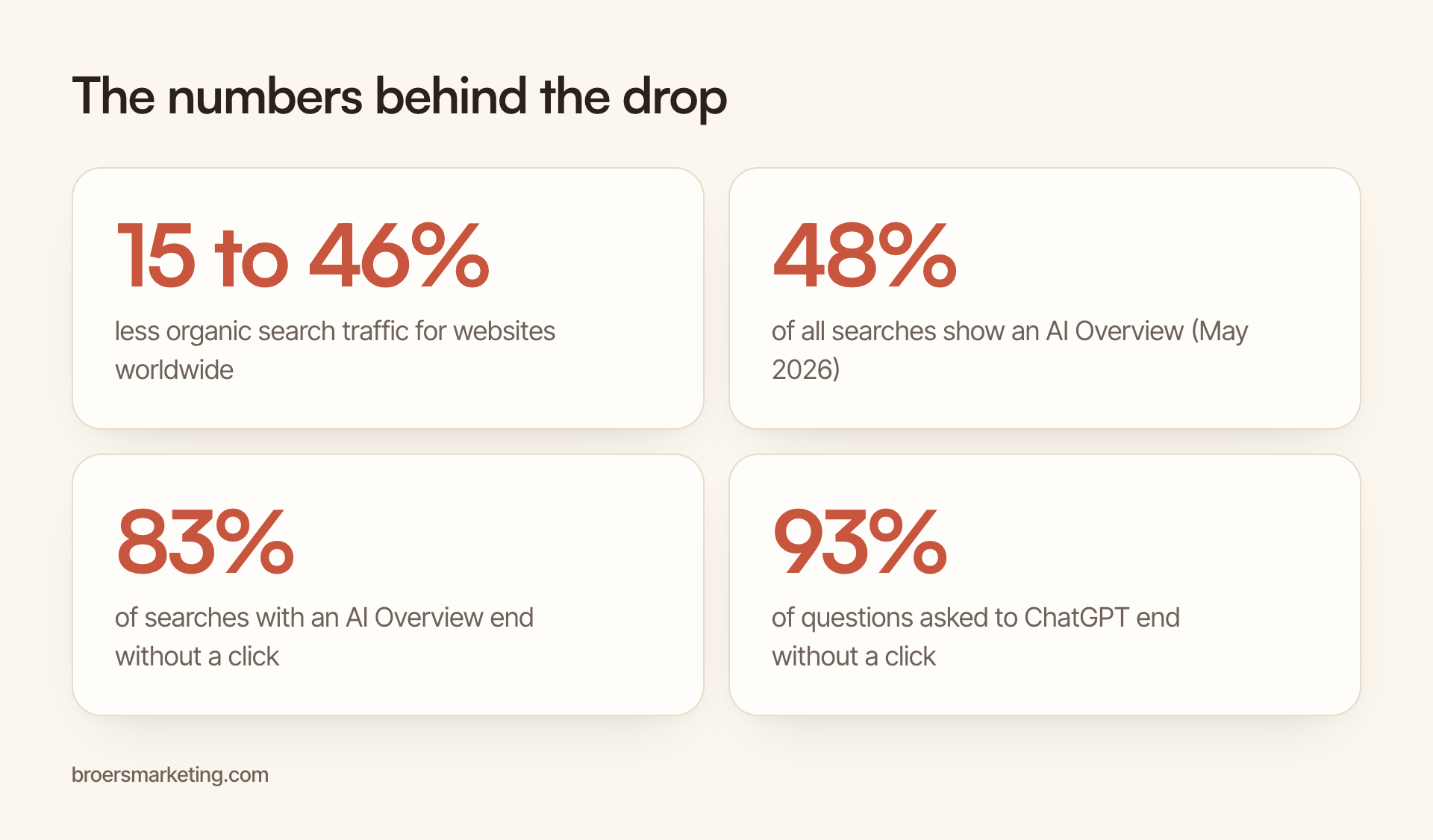
- Organic search traffic is down 15 to 46 percent for websites worldwide.
- AI Overviews appear on roughly 48 percent of all searches (May 2026).
- 83 percent of searches with an AI Overview end without a click. On ChatGPT that rises to 93 percent.
What are Google AI Overviews?
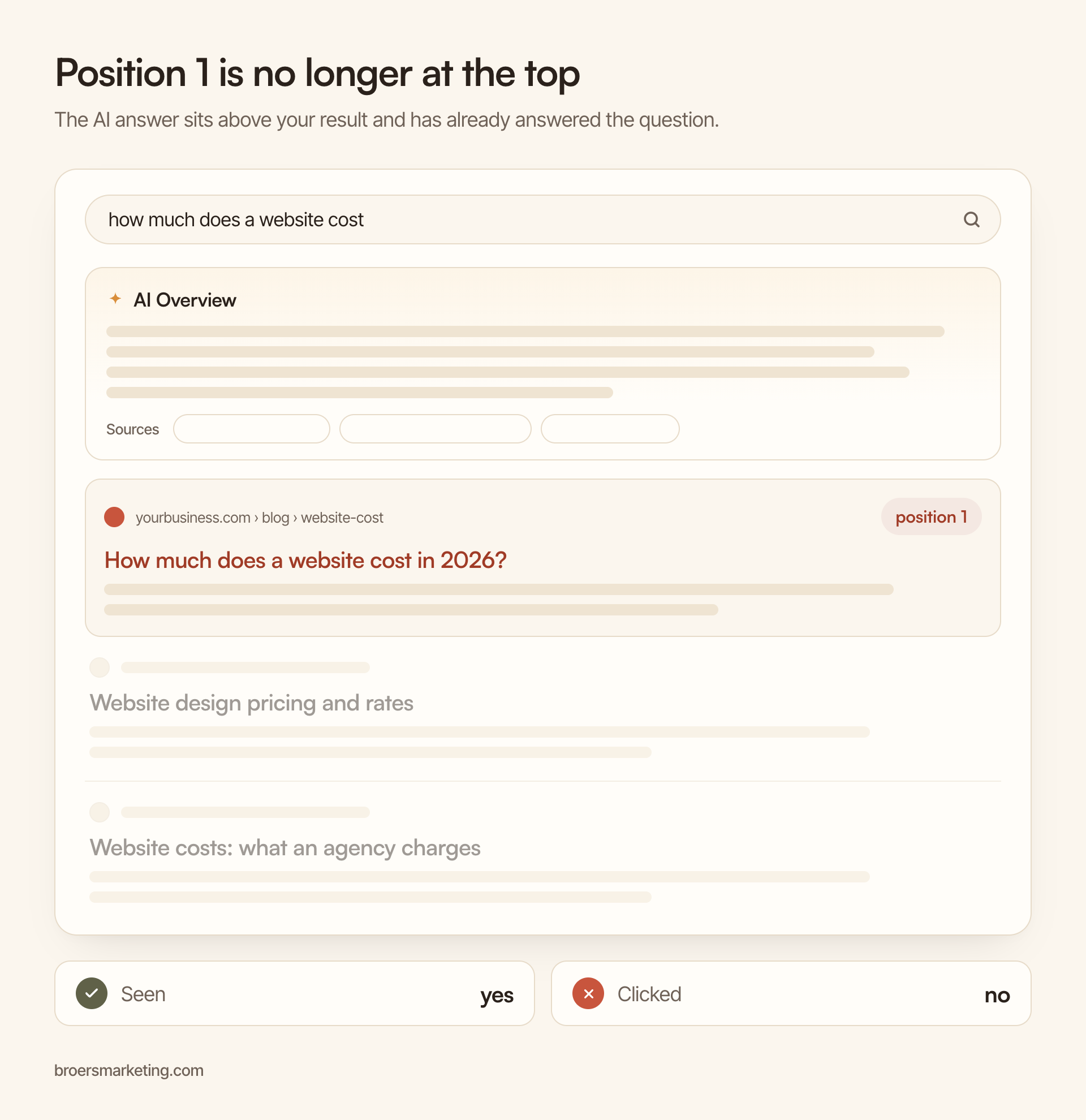
Google AI Overviews are automatically generated summaries that Google shows above the organic results. They combine information from several sources and answer the search query right on the results page, without the user clicking through.
Sometimes a source gets a mention in the AI answer, sometimes it does not. So your page counts twice: as a source for the AI answer and as a click destination. That distinction, being visible in the summary but getting no click, is what makes your Search Console numbers so confusing.
Why do your impressions stay high while your clicks drop?
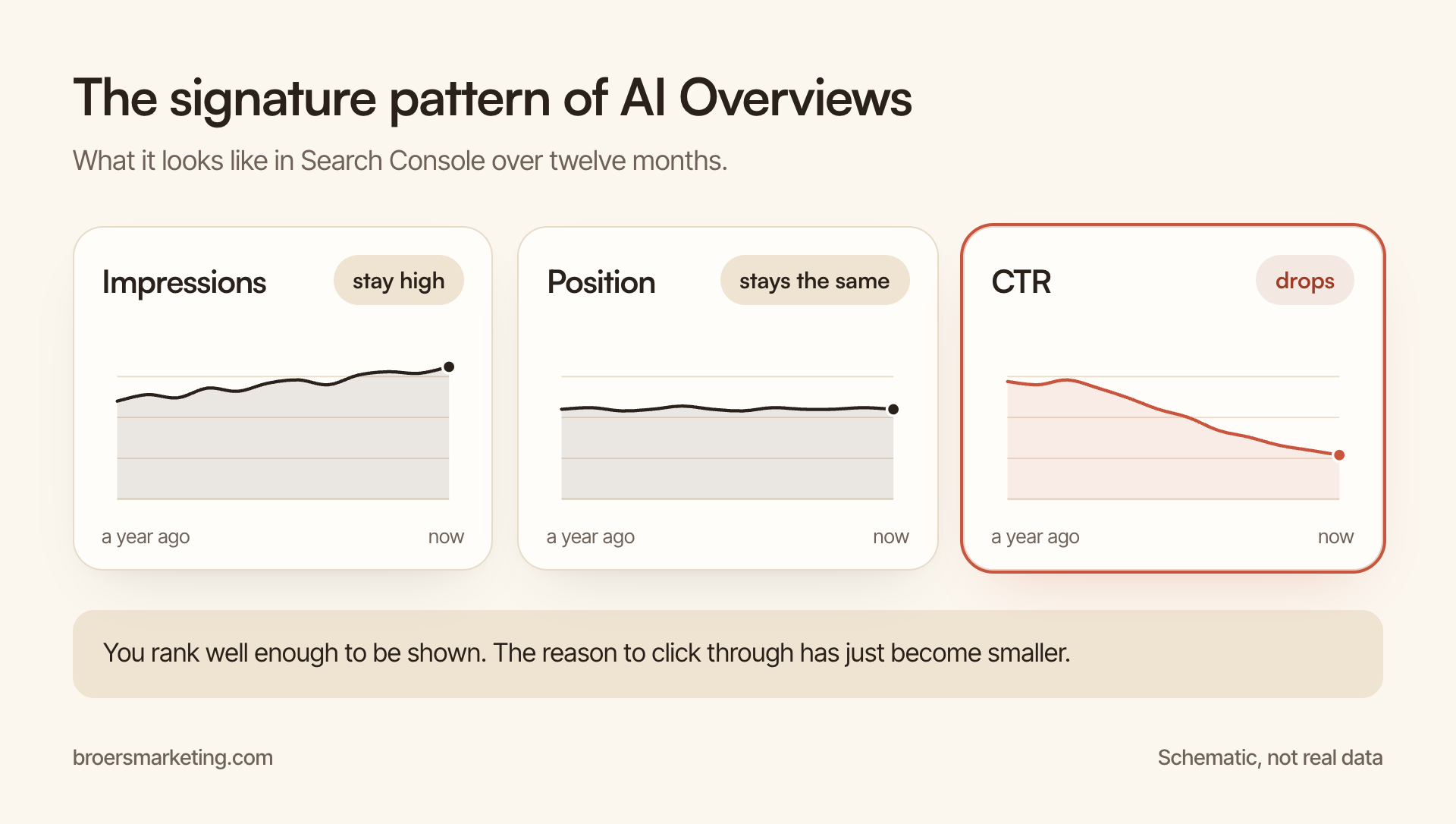
Because your page is still in the results, but the visitor's attention shifts to the AI answer at the top. You rank well enough to be shown, hence the impressions. The reason to click through has just become smaller.
You see this pattern mostly on informational search terms: questions like “how does X work”, “what is Y” or “what does Z cost”. Research by Seer Interactive shows that click-through on searches with an AI Overview is far lower than on comparable searches without one. High impressions, stable position, falling CTR: that is the signature pattern of AI Overviews.
ChatGPT as a silent competitor
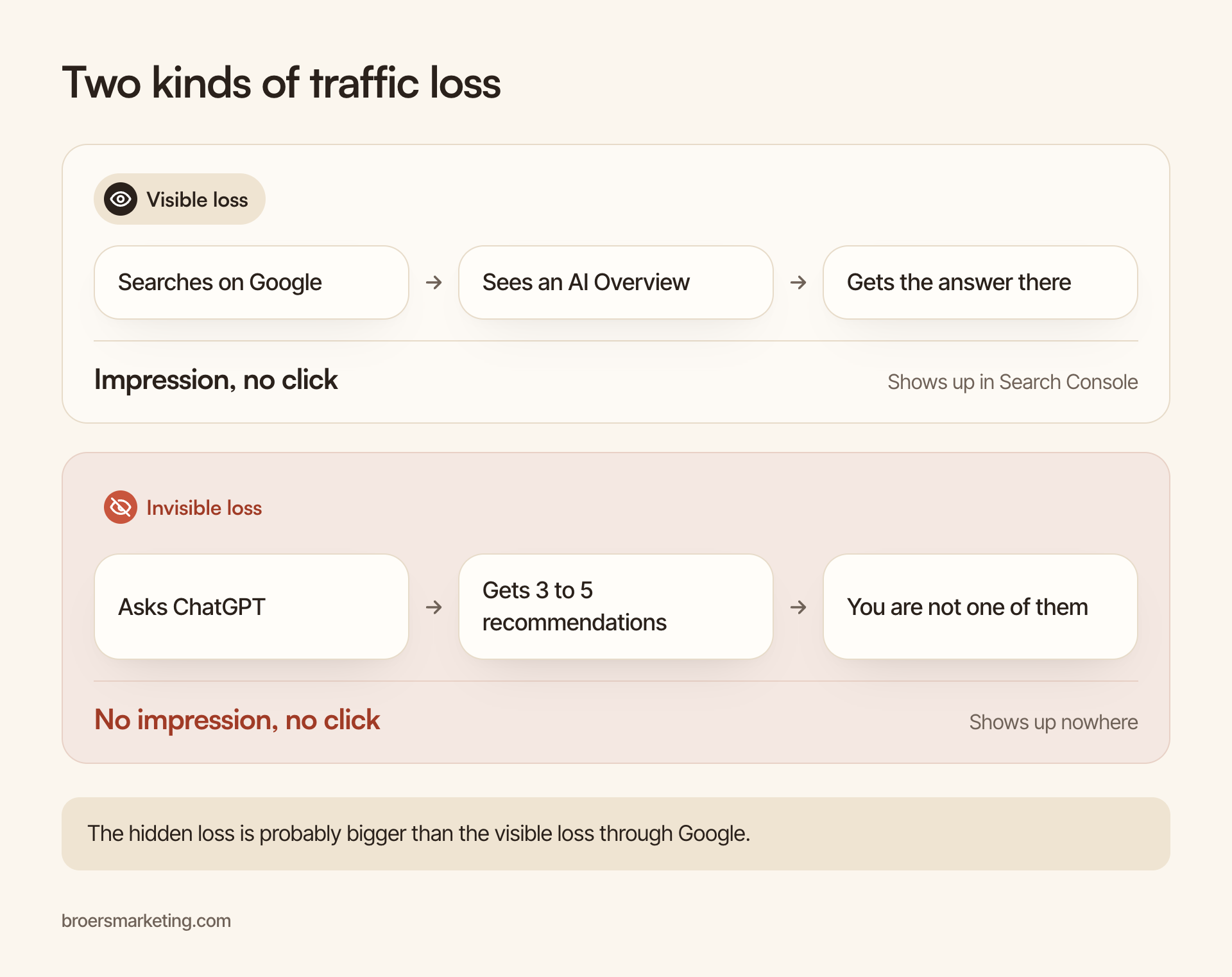
The drop in your Analytics tells only half the story. The other half is traffic you never received, because the user never searched on Google. Those searches do not show up in your Search Console. You see no drop, because there never was an impression.
More and more people start with an AI assistant instead of Google:
- ChatGPT now handles billions of queries a day, a large share of them questions that used to go to Google: product comparisons, recommendations, how-tos and local searches.
- Perplexity and Microsoft Copilot (built into the Microsoft ecosystem) answer millions more.
Ask ChatGPT “which accounting software is best for a new business” and you get three to five recommendations. If you are not named, you have lost a potential customer without knowing it. No impression, no bounce, no signal. The hidden traffic loss is probably bigger than the visible loss through Google.
The good news: the AI traffic that does come in is high quality. The AI has already made a preselection, so that visitor arrives with a concrete expectation and high buying intent. Visitors who click through despite the summary stay on the page for about six minutes on average. The click that disappears is usually the searcher who already had their answer. They were not ready to get in touch yet.
Which content is most at risk?
Not every page gets hit equally hard. It depends on your content type and search intent:
- Informational explainer pages (high risk): AI answers “what is” and “how does it work” directly. No reason to click through.
- Cost guides and comparisons (high risk): cost questions trigger AI Overviews strongly, even at a high position.
- How-tos and step-by-step guides (medium): AI shortens the steps. Whoever wants detail still clicks.
- Local service providers (low risk): local search intent leads to map results, not to AI answers.
- Transactional pages (low risk): whoever wants a quote or a purchase is ready to act.
- Brand and about pages (low risk): branded searches go straight to your website.
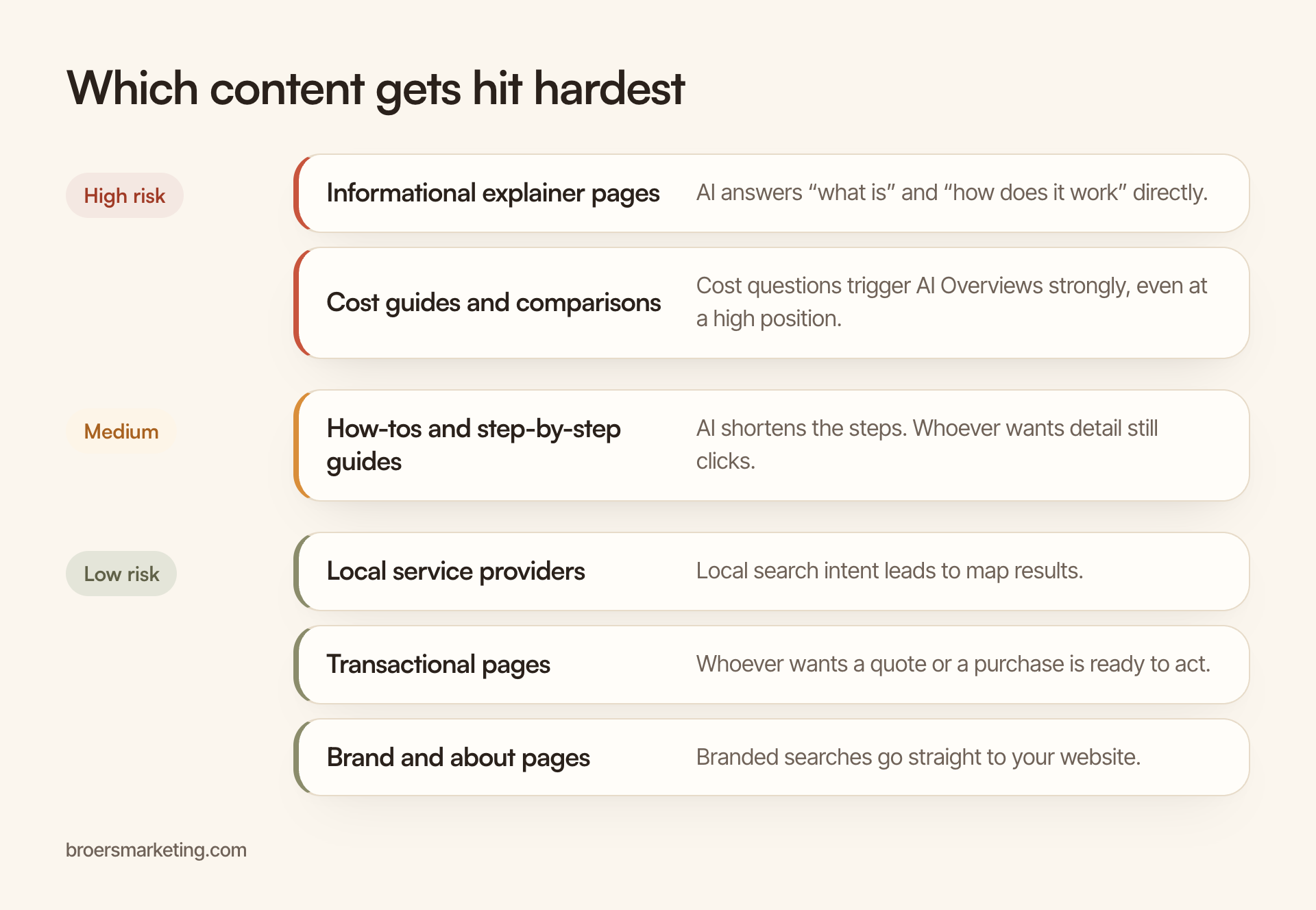
In short: if you have a lot of informational blog content, you feel this the hardest. If you mostly run on local or transactional pages, the damage is limited.
A drop in clicks is not a drop in revenue
Important to keep in mind: fewer clicks does not automatically mean less revenue. The visitor who drops off often already had their answer and was not ready to buy. Whoever stays is warmer and further along in the buying process. Put your click drop next to your inquiries or revenue over the same period. If those lines move together, there is less going on than Search Console suggests. If they diverge, that deserves attention.
What can you do about it?
You cannot steer what you do not measure. Three steps to stay visible, including inside the AI answers themselves:
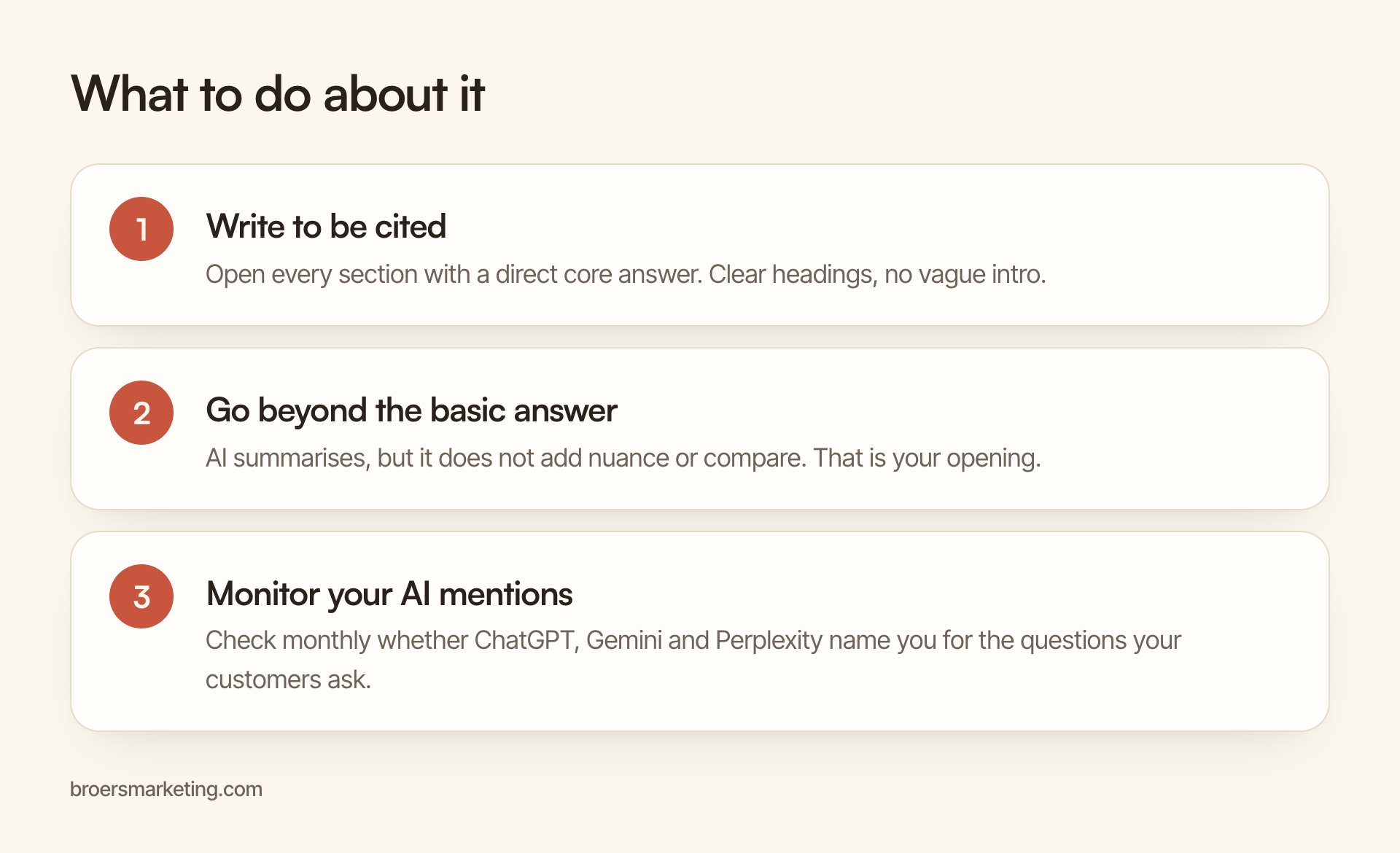
- Write to be cited, not only for the click. Open every section with a direct core answer, use clear headings and drop the vague intros. AI picks up self-contained, clear passages.
- Go beyond the basic answer. AI Overviews summarise, but they do not add nuance, compare, or give a personal perspective. That is exactly where your opening is.
- Monitor your AI mentions. Check monthly whether ChatGPT, Gemini and Perplexity name you for the questions your customers ask. This is called Generative Engine Optimization: making sure you are recognised and cited not only in Google, but in AI answers too.
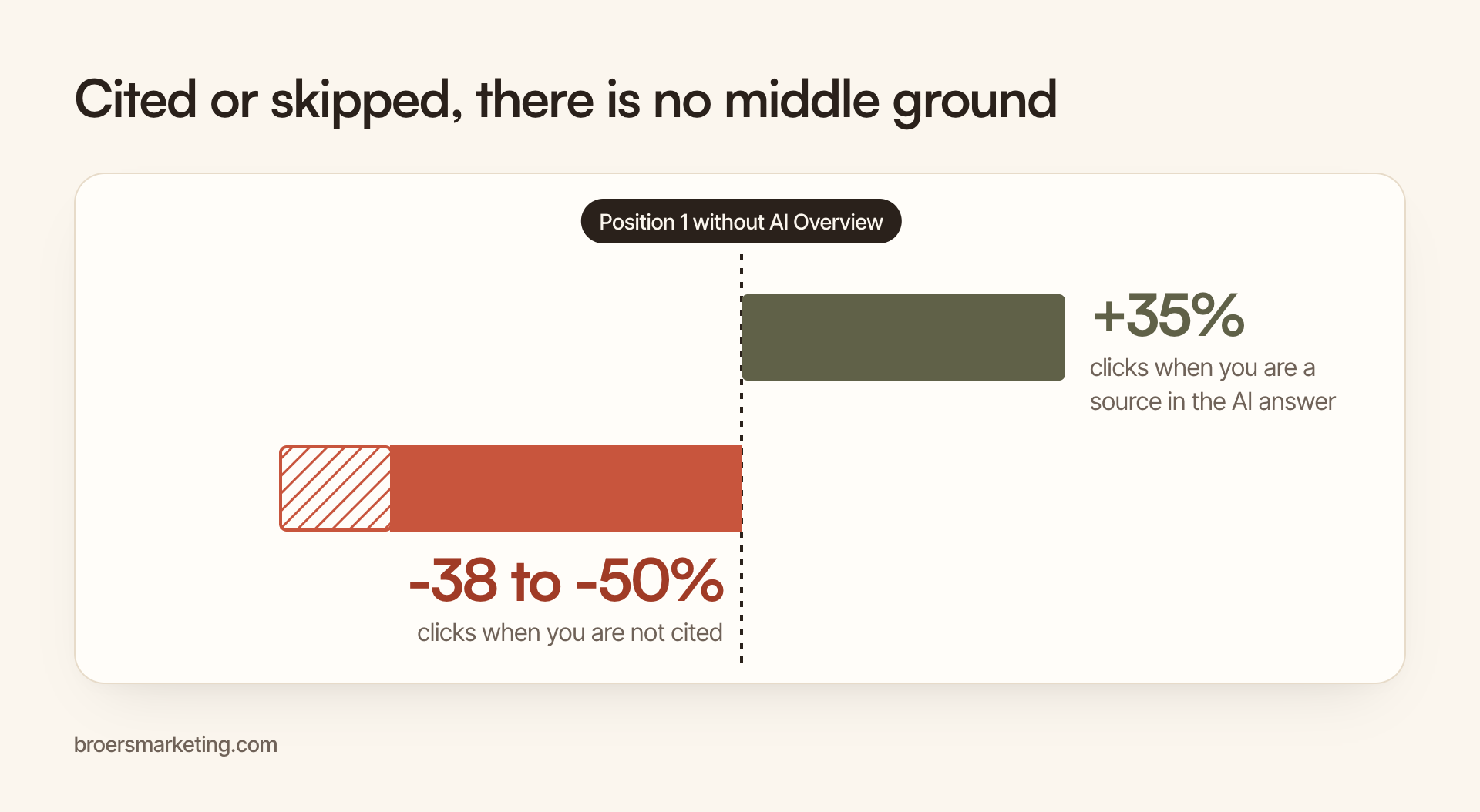
Why this pays off: cited sources get roughly 35 percent more clicks than position 1 without an AI Overview. Pages that are not cited lose 38 to 50 percent. It is winner takes all, and there is no middle ground.
Conclusion
Your traffic is not dropping because you are doing something wrong, but because the rules have changed. Rankings have been decoupled from traffic, and a growing share of your audience asks their question directly to an AI. The win is not in chasing more clicks, but in being cited by the AI your customers already use.
Curious whether AI recommends your business? I do a free AI visibility check: I test the questions your customers ask and show you whether you get named, and where you get skipped. No strings attached.
Email robin@broersmarketing.com, use the contact form or send a message on LinkedIn. You have the results within a few days.
Frequently asked questions
Because Google increasingly shows an AI Overview above your result. The visitor gets their answer there and does not click through. Your impressions stay high, your CTR drops.